
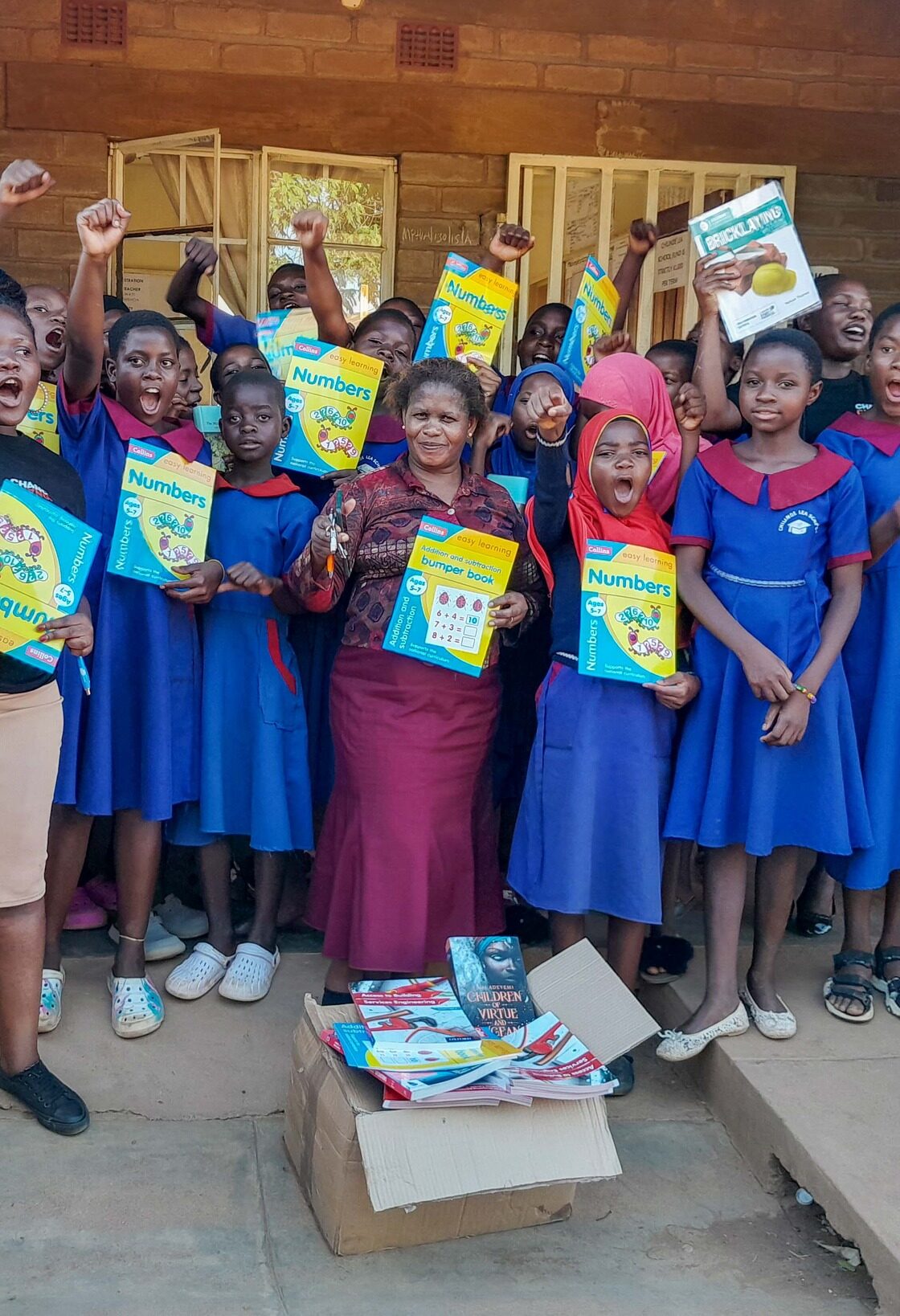
Investing in Education, Transforming Futures
The boxes of books arrive at Chilinde Primary School in Lilongwe on an ordinary Thursday morning, but their impact will be anything but ordinary. Donated by Mwayi Wosintha, these volumes represent more than educational resources stacked on library shelves.
They represent windows into worlds most of these children have never glimpsed, keys to knowledge that could transform their futures, and tangible evidence that their education matters to people beyond their immediate community.
The Educational Resource Gap in Malawi
To understand the significance of this donation, one must first understand the context of educational resources in Malawi’s primary schools. Whilst Malawi offers free primary education—a progressive policy that has dramatically increased school enrolment—the system struggles with chronic under-resourcing that affects every aspect of learning.
School libraries, where they exist at all, often contain outdated textbooks, limited reference materials, and few if any books purely for reading pleasure. Many schools share single textbooks amongst multiple students. The concept of a child taking a book home to read, exploring topics beyond the prescribed curriculum, or discovering the joy of reading for its own sake remains a luxury rather than a standard educational experience.
The impact extends beyond academic knowledge. Children who lack access to diverse books miss exposure to different cultures, ideas, and possibilities. Their horizons remain limited to their immediate environment. Vocabulary development suffers. Critical thinking skills that emerge from engaging with varied texts fail to develop fully. The foundation for lifelong learning—the understanding that books can answer questions, open new interests, and provide both education and escape—never gets established.
This is the reality that Chilinde Primary School faced before Mwayi Wosintha’s donation, and it’s the reality countless other Malawian schools continue to face. The school had a library space but insufficient books to make it the vibrant learning hub it could be. Teachers wanted to broaden their students’ knowledge and support deeper learning, but lacked the resources to do so effectively.
More Than Just Books on Shelves
The books donated by Mwayi Wosintha weren’t selected randomly or simply to fill empty shelves. The donation was carefully curated to include relevant educational materials that align with the primary school curriculum whilst also broadening students’ exposure to knowledge beyond their textbooks.
Reference materials help students research topics more deeply, moving beyond rote memorisation to genuine understanding. A child studying Malawian geography can now access maps, photographs, and detailed information rather than relying solely on a teacher’s verbal descriptions. Science concepts become clearer when students can see diagrams, read explanations at their own pace, and explore related topics that spark their curiosity.
Age-appropriate reading books serve a different but equally crucial purpose. They develop literacy skills through practice and pleasure rather than pressure. A child who struggles with prescribed texts might discover confidence through a story that captures their imagination. Reading for enjoyment creates positive associations with books and learning, whilst simultaneously building vocabulary, comprehension, and fluency in ways that purely instructional texts cannot.
The donation also recognises different learning levels within the same grade. Not all Standard 4 pupils read at the same level; some need simpler texts to build confidence, whilst others hunger for more challenging material. A well-stocked library accommodates this diversity, allowing teachers to differentiate instruction and students to progress at their own pace.
Perhaps most importantly, the books broaden these children’s knowledge of the world beyond their immediate experience. Through these pages, rural Malawian children can learn about ocean ecosystems they’ve never seen, understand how technology works, explore different cultures and histories, and encounter ideas that expand their sense of what’s possible in life. This exposure plants seeds of aspiration and curiosity that may not bear fruit for years but will fundamentally shape how these children see themselves and their potential futures.
The Ripple Effects of Educational Investment

The immediate beneficiaries of this book donation are obvious: the students and teachers at Chilinde Primary School. But the ripple effects extend far beyond the school’s boundaries, touching families, communities, and potentially shaping Malawi’s future in ways both subtle and profound.
Children who develop strong literacy skills and broad knowledge bases perform better academically, increasing their chances of progressing to secondary school and beyond. In a country where educational attainment directly correlates with economic opportunity, these improved outcomes can lift entire families out of poverty. A child who excels in school and eventually secures professional employment doesn’t just change their own trajectory; they gain the means to support siblings’ education, improve family living conditions, and contribute to community development.
The impact on teaching quality shouldn’t be underestimated either. Teachers with access to diverse educational resources can deliver richer, more engaging lessons. They can assign research projects that develop critical thinking rather than just memory. They can recommend books that address individual students’ interests and needs. Professional satisfaction increases when teachers have the tools to teach effectively, which in turn improves retention in a profession that often loses talented individuals to better-paying opportunities.
Community perceptions of education shift when children bring home knowledge from books, discuss what they’re learning with parents, and demonstrate growing competence and curiosity. Families see tangible returns on the investment of sending children to school rather than keeping them home to help with work. This reinforces the value of education and encourages continued enrolment, particularly for girls who face additional pressures to abandon schooling for domestic responsibilities or early marriage.
At a societal level, investments in primary education yield returns across generations. Today’s well-educated children become tomorrow’s teachers, healthcare workers, entrepreneurs, and community leaders. They make more informed decisions about health, agriculture, and resource management. They participate more effectively in democratic processes. They’re better equipped to adapt to changing economic conditions and technological advancement. The books on Chilinde’s library shelves today may influence Malawi’s development trajectory decades from now in ways impossible to measure but impossible to deny.
Community Engagement Beyond the Reformatory Centre
Mwayi Wosintha’s book donation to Chilinde Primary School reflects the organisation’s understanding that sustainable change requires community-wide engagement. Whilst the Private Reformatory Centre and rehabilitation programmes remain at the heart of their work, the organisation recognises that children don’t enter the justice system in isolation. They come from communities, families, and schools—and meaningful intervention must address these broader contexts.
Supporting primary education in surrounding communities serves multiple strategic purposes. It helps prevent vulnerable children from entering the justice system by providing educational opportunities and positive environments. It builds relationships with schools that can support reintegration when young people leave the reformatory centre. It demonstrates the organisation’s commitment to the wider community’s wellbeing, not just to the specific children in their programmes.
The donation also embodies Mwayi Wosintha’s fundamental principle: to inspire a future worth having. Education is perhaps the most powerful tool for creating such futures. By investing in the education of children who have never been in conflict with the law, the organisation helps ensure that fewer children face the desperate circumstances that drive offending. Prevention, after all, is more effective and humane than intervention after the fact.
This community engagement approach aligns with the organisation’s values of partnership and collaboration. Rather than operating in isolation, Mwayi Wosintha actively seeks opportunities to strengthen the broader educational and social systems that affect vulnerable children. Book donations represent one form of this engagement; others include partnerships with local leaders, consultation with traditional authorities, and collaboration with government agencies working in child protection and education.
The Transformative Power of Literacy and Learning
There’s a reason why access to books and literacy development feature so prominently in development programmes worldwide. The correlation between literacy and almost every positive development indicator—health outcomes, economic productivity, democratic participation, gender equality—has been demonstrated repeatedly across diverse contexts.
Literacy enables individuals to access information independently, from health guidelines to legal rights to market prices for agricultural products. It facilitates communication beyond one’s immediate community, whether through written correspondence, digital media, or formal documentation. It provides the foundation for all further learning, whether vocational training, professional education, or self-directed skill development.
But the impact extends beyond these practical benefits. Reading expands empathy by exposing readers to diverse perspectives and experiences. It develops critical thinking by presenting different viewpoints and requiring engagement with complex ideas. It nurtures imagination and creativity, qualities essential for innovation and problem-solving. It provides tools for self-expression and advocacy, enabling individuals to articulate their needs, rights, and aspirations.
For children in resource-constrained environments, books offer something equally precious: proof that there’s more to the world than what they see around them. A child in rural Malawi reading about marine biology learns that oceans exist and contain wonders worth studying. A girl reading about women scientists and leaders internalises that such paths are possible for women. A young person reading about different cultures and countries understands that the world is vast and diverse, and that their own circumstances, whilst real, aren’t the only possible reality.
This expansion of horizons matters profoundly for children whose immediate environment may offer limited models of success or opportunity. The books donated to Chilinde Primary School don’t just support the current curriculum; they plant seeds of aspiration and possibility that may take years to germinate but will ultimately shape how these children envision and pursue their futures.
Small Gestures, Lasting Impact
A book donation might seem like a modest intervention compared to the complex challenges facing Malawi’s education system. It doesn’t solve overcrowded classrooms, teacher shortages, or infrastructure deficits. It doesn’t address poverty, food insecurity, or the myriad factors that prevent children from attending school regularly.
But perhaps that perspective misses the point. Transformative change rarely happens through single dramatic interventions. It accumulates through countless smaller actions, each addressing specific needs, each making specific situations slightly better. The books now shelved in Chilinde Primary School’s library won’t solve all educational challenges, but they will change the educational experience for hundreds of children who pass through that school in coming years.
Some of those children will discover a love of reading that shapes their entire lives. Some will gain knowledge that sparks career aspirations they wouldn’t otherwise have conceived. Some will simply perform slightly better in school because they had access to reference materials when they needed them. Each of these outcomes matters. Each represents a child whose future possibilities expanded because someone invested in their education.
Mwayi Wosintha’s donation to Chilinde Primary School embodies the organisation’s commitment to comprehensive community engagement and their belief that every child deserves opportunities to learn, grow, and envision positive futures. It reflects understanding that preventing children from entering the justice system is as important as rehabilitating those already in it, and that education is perhaps the most powerful preventive tool available.
In the coming years, as children pull these books from library shelves, settle into reading corners, and lose themselves in pages of knowledge and story, the donation’s impact will ripple outward in ways both measurable and immeasurable. Some effects will appear in test scores and progression rates. Others will manifest in quieter ways: a child’s expanded vocabulary, a new interest sparked, a world glimpsed that didn’t previously exist in their imagination. These are the kinds of changes that build better futures, one page, one child, one community at a time.