
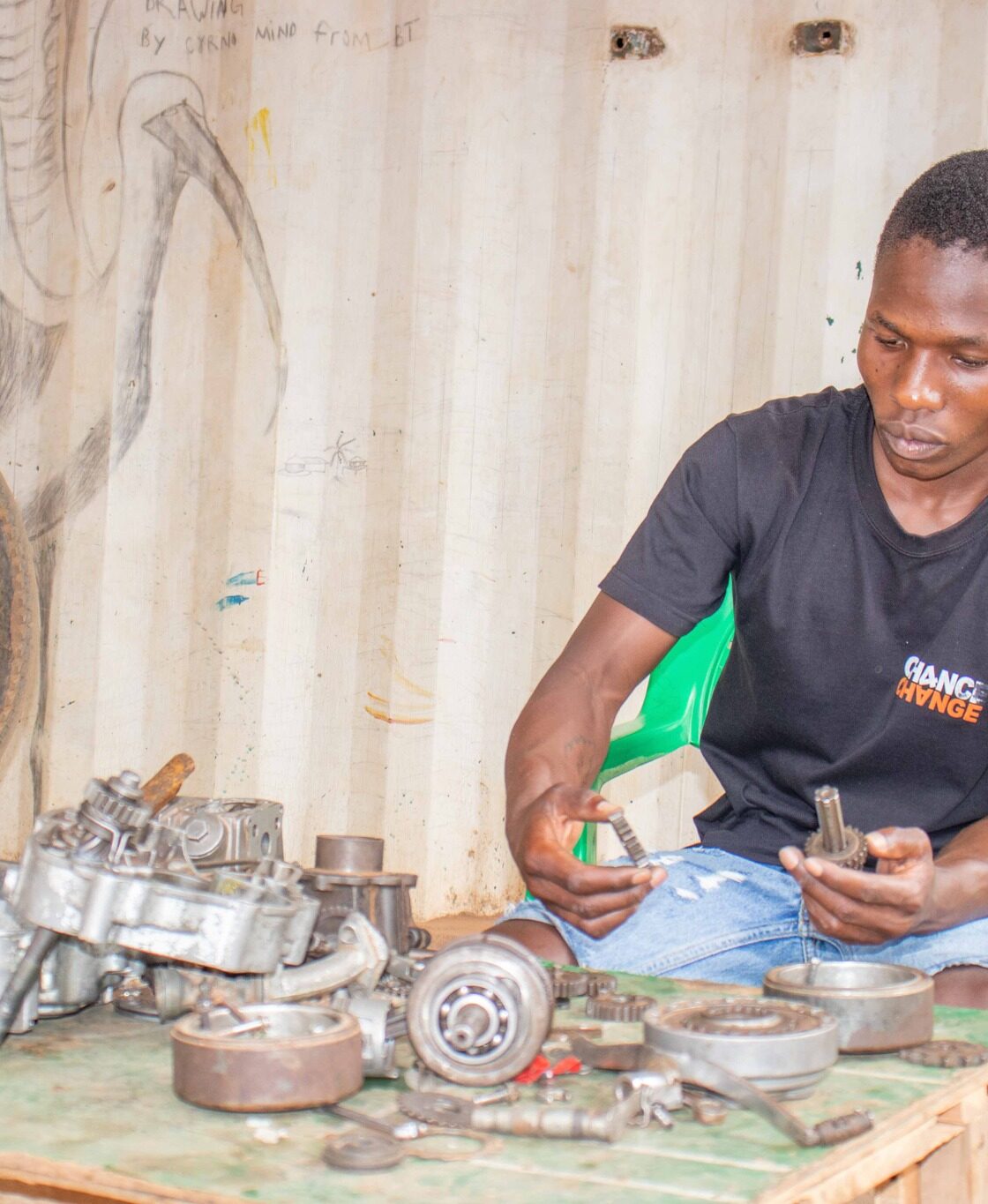
Building Futures One Engine at a Time
In the heart of Malawi, young people at Mwayi Wosintha’s Private Reformatory Centre are developing extraordinary skills, such as complex motorbike repair techniques, that are transforming not just motorbikes, but their entire futures.
The ability to completely disassemble and reassemble a motorbike engine—one of the most technically demanding skills in the mechanics trade—represents just one aspect of the comprehensive vocational training these young people receive.
The Art and Science of Engine Repair
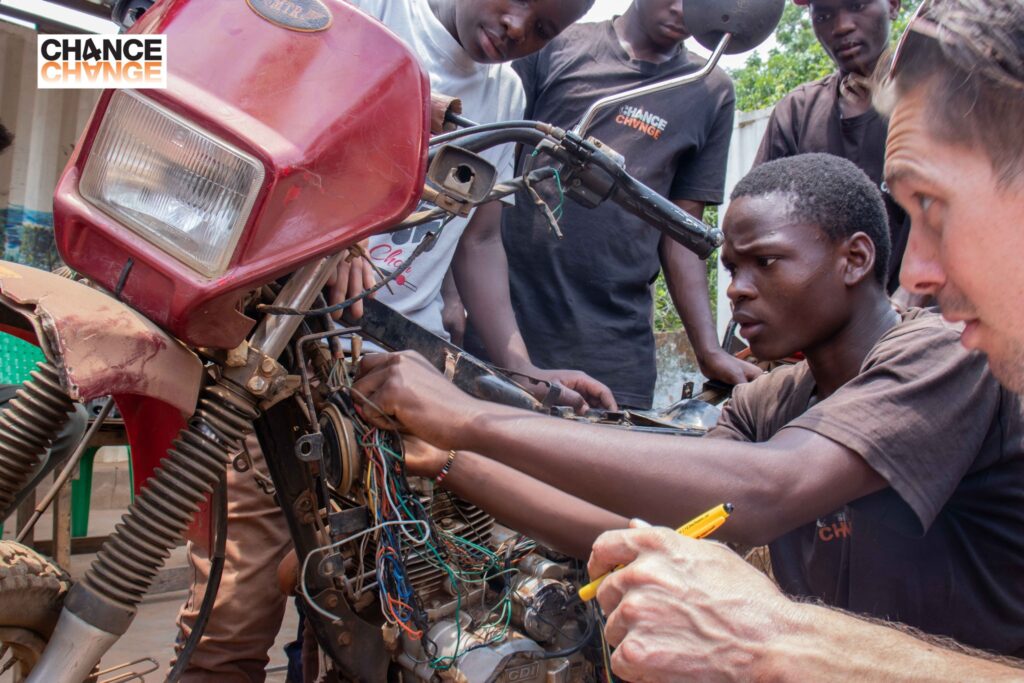
Reassembling a motorbike engine is no small feat. Every component must be perfectly aligned and torqued to exact specifications, demanding precision and attention to detail that takes years to develop. The work requires sophisticated problem-solving abilities to diagnose faults and determine the best repair approach, alongside deep technical knowledge of how different engine systems work together. Patience and persistence are essential, as some repairs can take days to complete properly, whilst the manual dexterity required to work with small parts and specialised tools comes only through extensive practice.
These are skills that traditionally take months, even years, to develop through conventional apprenticeships. Yet the young participants in Mwayi Wosintha’s mechanics department are achieving proficiency that enables them to repair any motorbike with confidence and ease, thanks to an intensive, well-structured training programme that combines hands-on experience with theoretical understanding.
More Than Just Mechanics: A Comprehensive Approach
What sets the mechanics training at Mwayi Wosintha apart is that it’s not delivered in isolation. As part of the organisation’s holistic ‘Three Pillars’ development model, young people receive an integrated programme that addresses not just technical skills, but the fundamental building blocks of sustainable, successful futures.
The foundational life skills component includes cognitive behavioural rehabilitation based on choice theory and reality therapy, helping participants understand their own behaviour and decision-making processes. They learn practical tools for managing emotions and navigating challenges, whilst building the confidence and self-worth that many lacked before entering the programme. This psychological and emotional foundation proves crucial when participants face the inevitable setbacks and difficulties of establishing themselves in business after release.
The technical competencies extend beyond engine repair to encompass the full spectrum of professional mechanics work. Participants receive hands-on training in motorbike repair and maintenance, learning safe workshop practices and proper tool usage. Crucially, they also develop customer service and business communication skills, understanding that technical excellence alone isn’t sufficient for success. Quality control and professional standards are emphasised throughout, instilling the discipline and attention to detail that will define their reputation as mechanics.
Perhaps most importantly, the business and enterprise training component equips participants with financial literacy and money management skills often completely absent from their previous education. They learn business planning and entrepreneurship, understanding how to market their services and build customer relations. Record-keeping and basic accounting, seemingly mundane skills, prove transformative for young people who may never have had a bank account or tracked income and expenses.
This integrated approach means that when young people complete their training, they don’t just know how to fix motorbikes—they know how to build sustainable businesses around their skills, manage money responsibly, communicate professionally with customers, and navigate the challenges of self-employment.
Real-World Impact: From the Workshop to Independence
The mechanics training programme is designed with one clear goal: enabling young people to generate sustainable income upon their reintegration into their communities. Through Mwayi Wosintha’s comprehensive reintegration programme, this goal becomes reality rather than aspiration.
Participants receive startup tools and equipment—the essential toolkit to begin working immediately upon release. This isn’t a token gesture; it’s a carefully selected set of professional-grade tools that enables genuine independent practice. Alongside the toolkit, they receive materials and initial stock, including parts and supplies to take on their first jobs without requiring capital they don’t have.
The support doesn’t end at the gate. Ongoing mentorship provides continued guidance from instructors and staff who understand both the technical challenges of establishing a mechanics business and the personal struggles of reintegrating into communities that may initially view former detainees with suspicion. Community connections prove invaluable, with staff actively creating links to potential customers and business opportunities, helping to overcome the trust barrier that might otherwise prevent young mechanics from securing their first clients.
Regular follow-up visits enable staff to problem-solve challenges as they arise, whether technical difficulties with complex repairs or personal struggles with family relationships or community acceptance. This sustained engagement transforms reintegration from a single event into an ongoing process of support and development.
The results speak for themselves. Within days of leaving the Private Reformatory Centre, a young person can be earning income repairing motorbikes in their community—a remarkable transformation from incarceration to economic independence that would be impossible without this comprehensive support structure.
The Multiplier Effect: Skills That Create Opportunity

The impact of mechanics training extends far beyond the individual participant. In rural Malawi, where motorbikes are often the primary means of transport for families and small businesses, a skilled mechanic becomes an invaluable community resource whose services ripple through the local economy.
One young person with these skills can provide affordable repair services to dozens of families, keeping essential transport running and enabling others to earn their livelihoods. As their business grows, they create employment opportunities for others, whether through formal apprenticeships or informal teaching. The knowledge doesn’t remain hoarded; successful mechanics often transfer skills to younger apprentices, perpetuating the cycle of opportunity.
The economic contribution extends beyond individual transactions. Local economic development accelerates when essential services become reliably available, and the presence of skilled tradespeople attracts further investment and activity. Perhaps most significantly, these young mechanics become positive role models for other young people in their communities, demonstrating that past mistakes need not define future possibilities.
Breaking the Cycle: Why Vocational Training Matters
Many young people who enter the justice system in Malawi do so because of poverty-driven circumstances rather than criminal inclination. They often lack education, employable skills, or viable pathways to legitimate income. The theft that led to their detention may have been driven by hunger; the choices they made were constrained by circumstances most people never face.
Without intervention, the cycle continues relentlessly. Release from custody without support, skills, or prospects leads almost inevitably back to the same desperate circumstances, the same impossible choices, and ultimately the same offending behaviour. The justice system becomes a revolving door, failing both the young people caught in it and the communities it purports to protect.
Vocational training in high-demand trades like mechanics changes this trajectory entirely. It provides marketable skills with immediate economic value, enabling young people to earn legitimate income from the day of their release. It creates a professional identity and sense of purpose that replaces the stigma of ‘ex-offender’ with the respected title of ‘mechanic’ or ‘tradesperson’. Community integration happens naturally through useful service provision, as neighbours who might otherwise shun a former detainee willingly bring their broken motorbikes for repair.
Economic independence reduces vulnerability to exploitation and the desperate circumstances that drive offending. Most importantly, it creates positive futures worth working towards—something many of these young people have never had. The difference between abstract rehabilitation programmes and practical skills training is the difference between hoping for change and making change inevitable.
A Model for Malawi and Beyond
Mwayi Wosintha’s mechanics training programme demonstrates what’s possible when young people are given genuine opportunities rather than just punishment. The organisation’s Private Reformatory Centre—Malawi’s first and only private reformatory—has pioneered a rehabilitative approach that addresses root causes rather than just symptoms, challenging the assumption that incarceration alone can solve the problem of youth offending.
The success of participants who have trained in the mechanics department proves that young people in conflict with the law are not beyond redemption. They are not fundamentally different from other young people; they simply lacked opportunities, education, and viable alternatives to the choices that brought them into detention. With the right support, training, and opportunities, they can develop extraordinary skills and build successful, crime-free futures that benefit themselves, their families, and their communities.
The model offers lessons for Malawi’s wider justice system and for other countries facing similar challenges. Punishment alone does not rehabilitate; skills, support, and genuine opportunities do. The investment required is substantial, but the alternative—the endless cycle of detention, release, and reoffending—costs far more in both human and economic terms.
Looking Forward: Skills for Tomorrow
As Mwayi Wosintha continues to expand and refine its vocational training programmes, the mechanics department remains a flagship offering. The demand for skilled motorbike mechanics in Malawi is substantial and growing, driven by increasing motorbike ownership and the reality that most families cannot afford to replace broken vehicles. Every young person who masters these skills is stepping into a future filled with opportunity, armed with abilities that will remain valuable for decades to come.
From the intricate work of reassembling a motorbike engine to the broader skills of running a successful repair business, participants are being equipped not just to survive, but to thrive. The transformation is profound: from desperate circumstances that drove them to offend, through detention and comprehensive training, to economic independence and community respect.
They’re not just fixing motorbikes—they’re rebuilding their lives, one engine at a time. In those quiet moments in the workshop, surrounded by tools and parts, covered in oil and grease, they’re learning something far more valuable than mechanical skills. They’re learning that their past need not define their future, that they have value and capability, and that the society which detained them is also willing to invest in their success. That lesson, combined with genuine skills and comprehensive support, makes all the difference between repeated offending and transformed lives.